Description
On the northern slopes of the Circeo promontory, the woods conceal the remains of several Roman rustic villas: the working farms of the ancient colony of Circeii, a far cry from grand coastal residences such as the Villa of Domitian.
Don't come looking for mosaics or columns. What survives here is what kept the countryside running: terraces, retaining walls and, above all, cisterns for collecting rainwater, which have weathered the centuries better than the houses themselves.
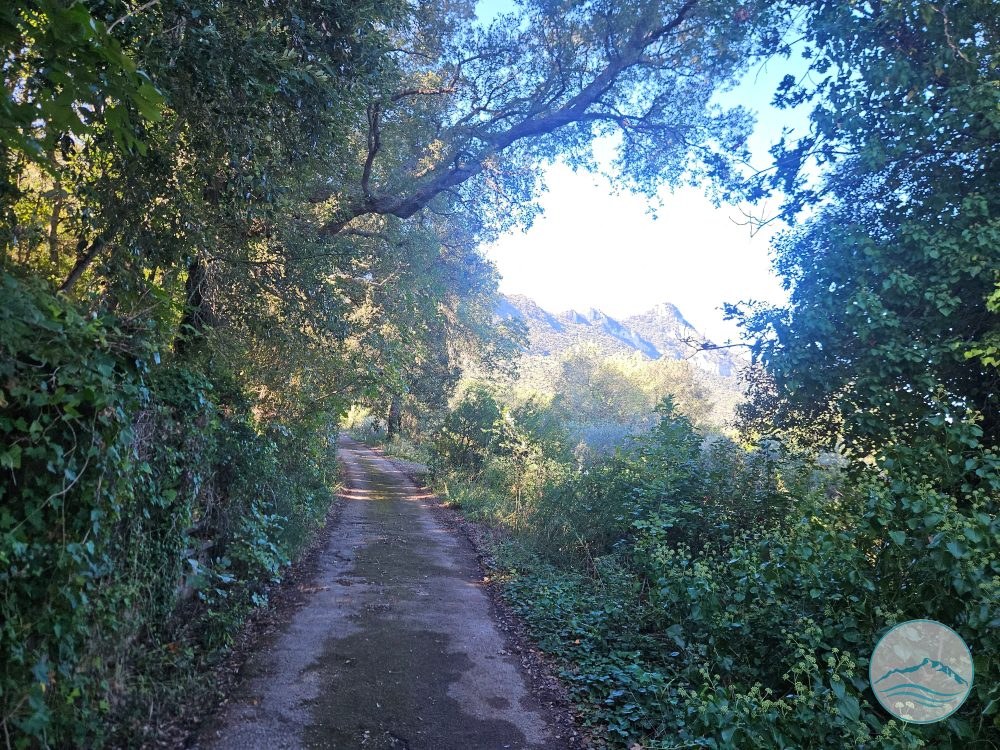
The route suits anyone who loves silence and antiquities off the beaten track. It follows the Park's trails 751 (Uliveto) and 755 (Brecciaro) and takes three to four hours.
A rustic villa combined the owner's residence (pars urbana) with a working section (pars rustica), complete with storerooms, olive and wine presses, tanks and cisterns. The "grotte" (caves) you will come across along the way are not natural caverns but ancient cisterns and reservoirs, known by that name in local tradition.
The stops, in walking order:
1. Grotta del Peretto, the starting point: one of the sites in Circeii where online archaeological records note a rustic villa.
About three hundred metres further up is the Secondo Peretto (also reachable by the paved road), facing the end of the Malpasso shortcut. This is where you take the path heading down into the valley towards the villas.
2. Villa della Grotta dei Banditi (160–180 m above sea level, about 800 metres from the Fontana di Mezzomonte): long stretches of retaining wall in opus incertum survive, along with the cistern that gives the site its name, used until about a century ago as a hideout and lookout over the Brecciaio valley.
The cistern, more than 16 metres long and visited by Ashby, Cipriani and Capponi, could be entered from above through a crack in the vault. This was blocked up in the early 20th century because it was a danger to livestock, and today no trace of it remains.
3. Cistern of the "Grotta della Sibilla": heading west at 200–250 m, a large cistern about 20 metres long and just over two and a half metres wide fills the entire platform on which a villa once stood. Its vault is well preserved, with a round manhole for letting water in and drawing it out and a small window on the north-west side; a short channel carried rainwater to it from a little stream. It is one of the most recognisable remains on the route.
4. Villa and cistern of the "Dieci Camere": descending into the Oliveto Baronale (some 3,000 trees across 22 hectares), halfway towards the houses of the former feudal estate (Tenuta ex feudo), you reach the ruins of another villa, whose front wall still stands tall, pierced by large windows.
Its water came from a cistern further uphill, made up of two parallel reservoirs, each divided into five chambers – hence the name, "Ten Rooms". The feed shaft is well preserved, but the structure is badly cracked and dangerous: view it from the outside only.
5. Villa and cistern Carella: about two hundred metres to the north-east, among the olive trees, a cistern with two parallel vaulted chambers supplied the villa below; one of the chambers has collapsed and is almost buried.
6. Fontana di Mezzomonte, in a small wood halfway up the promontory: this horseshoe-shaped spring, roughly 23 × 20 metres, has sections in triangular bricks from the age of Domitian and was heavily restored under the Papal States. It probably supplied the nearby villas; until recent times it formed a small pond that powered the mill known as La Mola, along the Fossa Augusta, and today it feeds the town aqueduct.
To return, you can skirt the olive grove and the scrubland back to the village, or follow the woods to the stepped path near the large Brecciaio quarry, which climbs to the saddle between the Guardia Orlando and Peretto hills and then descends to Via XXIV Maggio.
The remains are often hidden by vegetation and partly unstable: do not climb over walls, enter the cisterns or remove any material.
Many of the area's historic trails are now hard going, and access to some parts of the promontory is restricted: check with the Park which routes are open before you set out.